
I know how confusing it gets when you are staring at a stack of boxes and have no idea which one fits your product.
The wrong box size can damage your item, increase your shipping cost, or waste packaging material.
In this guide, I will walk you through the shipping box sizes chart, standard dimensions, carrier rules, and how to pick the right box for any product.
I have spent time working through packaging decisions for small businesses, so I know what works.
By the end, you will feel confident choosing the right box every time.
Why Shipping Box Sizes Matter for Cost, Safety, and Efficiency

Box size affects more than just fit. It directly impacts your shipping bill.
Carriers like UPS, FedEx, and USPS calculate charges based on size and weight, so a box that is too big costs more even if the product inside is light.
A box that is too small can damage your item in transit. Getting the right size lowers your cost, keeps products safe, speeds up packing, and cuts down on waste.
Most people searching for a shipping box sizes chart just want a fast, clear answer, and that is exactly what this guide gives you.
Shipping Box Sizes Chart (Standard Dimensions at a Glance)

A complete size breakdown from small to extra-large for every type of product you ship.
Small Shipping Box Sizes
Small boxes are used for lightweight and compact items. These boxes work well for products that do not need much space.
Common small box dimensions:
- 6 x 4 x 4 inches
- 8 x 6 x 4 inches
- 10 x 8 x 4 inches
These sizes are ideal for jewelry, small electronics, and accessories. They are cheap to ship and easy to store in bulk.
Medium Shipping Box Sizes
Medium boxes handle most everyday ecommerce products. They offer enough space for padding while keeping shipping costs reasonable.
Common medium box dimensions:
- 12 x 10 x 6 inches
- 14 x 10 x 8 inches
- 16 x 12 x 8 inches
These boxes are popular with online stores selling clothing, books, and similar goods.
Large Shipping Box Sizes
Large boxes are used for bulk shipments and heavier products. These require more care with weight limits set by carriers.
Common large box dimensions:
- 18 x 14 x 12 inches
- 20 x 16 x 12 inches
- 24 x 18 x 12 inches
Use these for home goods, appliances, or multiple items packed together.
Extra-Large Shipping Box Sizes
Extra-large boxes handle moving and oversized goods. They are harder to manage and often attract dimensional weight charges.
Common extra-large box dimensions:
- 24 x 24 x 24 inches
- 30 x 20 x 20 inches
- 36 x 24 x 18 inches
These are best for furniture parts, sporting equipment, or large sets of items.
How to Choose the Right Shipping Box Size

Guidance to measure, pad, and pick the box that fits your product perfectly.
How to Measure Product Dimensions Correctly
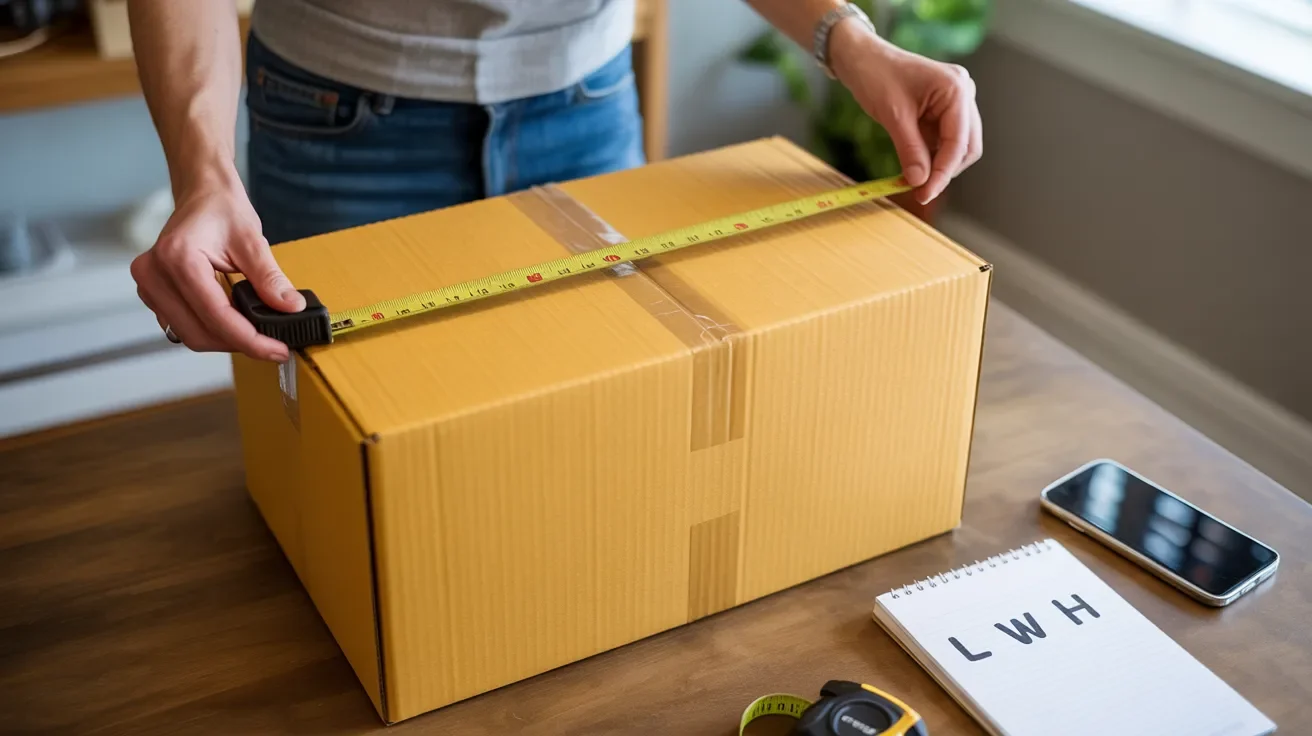
Always measure the longest, widest, and tallest point of your product. Use a tape measure and round up to the nearest inch.
For irregular shapes, measure the outer boundaries as if the product were inside a box. That gives you the minimum interior box size you need.
Adding Cushioning Space
After you have the product dimensions, add 2 to 3 inches on each side for padding. This is where bubble wrap, foam inserts, or packing peanuts go.
Do not skip this step. A perfectly fitting box with no padding is risky for fragile items.
Matching Box Size with Weight and Fragility
Heavier products need stronger boxes, often corrugated double-wall boxes. Fragile items need extra padding space.
Soft items like clothing can go in smaller boxes with less padding. Hard electronics need more buffer space on all sides.
Avoiding Oversized or Undersized Packaging Mistakes
Oversized boxes cost more to ship and can cause products to shift and break. Undersized boxes put pressure on the product and may not close properly.
Always test your fit before ordering boxes in bulk.
Shipping Box Sizes for Ecommerce and Retail Businesses

How online sellers and fulfillment teams use standard sizes to save time and cut costs.
Standard Box Sizes Used in Online Stores and Fulfillment Centers
Most fulfillment centers stock a set of 4 to 6 standard box sizes. Having a defined set reduces time spent choosing the right box for each order.
Popular sizes in ecommerce:
- 8 x 6 x 4 inches (small accessories)
- 12 x 10 x 6 inches (clothing, books)
- 16 x 12 x 8 inches (electronics, bundles)
- 20 x 16 x 12 inches (bulk orders)
Subscription Box and Mailer Box Sizing Standards
Subscription boxes have their own sizing rules. Most are designed to fit a flat rate or standard shipping zone to keep costs predictable.
Common subscription box sizes range from 9 x 6 x 3 inches to 12 x 9 x 4 inches, depending on the product category.
Mailer boxes are thinner and ideal for flat items like clothing or printed materials.
Why Consistent Box Sizes Improve Packing Speed and Branding
When your team uses the same box sizes every day, packing becomes faster. There is no guesswork. Packers know which box to grab.
Consistent sizing also helps with branded packaging. You can print custom designs and keep your look uniform across every order.
Tips for Saving Money on Shipping With the Right Box Size
Small changes in box size can lead to big savings on every shipment you send.
- Always measure your product before picking a box to avoid paying for empty space.
- Use padded mailers for soft or flat items instead of full-sized boxes.
- Calculate DIM weight before finalizing your box choice to avoid surprise charges.
- Compare rates across USPS, UPS, and FedEx for the same box dimensions.
- Negotiate shipping rates with your carrier if you send more than 500 boxes a month.
Conclusion
Choosing the right box size comes down to a few simple steps. Measure your product, add 2 to 3 inches of padding space, calculate DIM weight, and match your box to carrier guidelines.
For odd-shaped products, custom boxes are worth considering. The right box protects your item, keeps costs down, and leaves a good impression on every customer who receives an order.
When I started using a shipping box sizes chart, my shipping bills dropped noticeably. Try applying even one tip from this guide today and drop a comment if it helped.
Frequently Asked Questions
What is the most common shipping box size?
The most common shipping box size is 12 x 10 x 6 inches. It fits a wide range of everyday ecommerce products like clothing, books, and small electronics.
How do I know which box size I need?
Measure your product length, width, and height. Then add 2 to 3 inches on each side for padding. That gives you the minimum interior box size you need.
Do larger boxes always cost more to ship?
Not always by weight, but larger boxes usually cost more due to dimensional weight pricing. Carriers charge based on whichever is higher, actual weight or DIM weight.
What is the difference between standard and custom box sizes?
Standard boxes come in fixed dimensions sold by most packaging suppliers. Custom boxes are made to match your product's exact measurements, which can reduce waste and DIM weight charges.
Can I reuse old shipping boxes?
Yes, you can reuse boxes if they are in good condition with no damage or weak spots. Remove or cover old labels and barcodes before sending to avoid delivery errors.